SFS CAMBODIA: FRESHWATER AND FOREST ECOSYSTEMS
(SEMESTER)
PROGRAM DETAILS
Terms | Fall, Spring
Credits | 18 semester-hour credits
Prerequisites | One college-level course in biology, ecology, or environmental studies/sciences with a grade of C or higher (or AP Biology or AP Environmental Science with a score of 4 or higher, or an IB Higher Level exam with a score of 5 or higher) | 2.8 GPA | 18 years of age by program start
Application Deadline | Fall: June 1. Spring: November 1. Rolling admissions: apply early, programs fill fast.
Financial Aid | All students are encouraged to apply for SFS financial aid, which includes need-based scholarships and SFS loans.
OVERVIEW
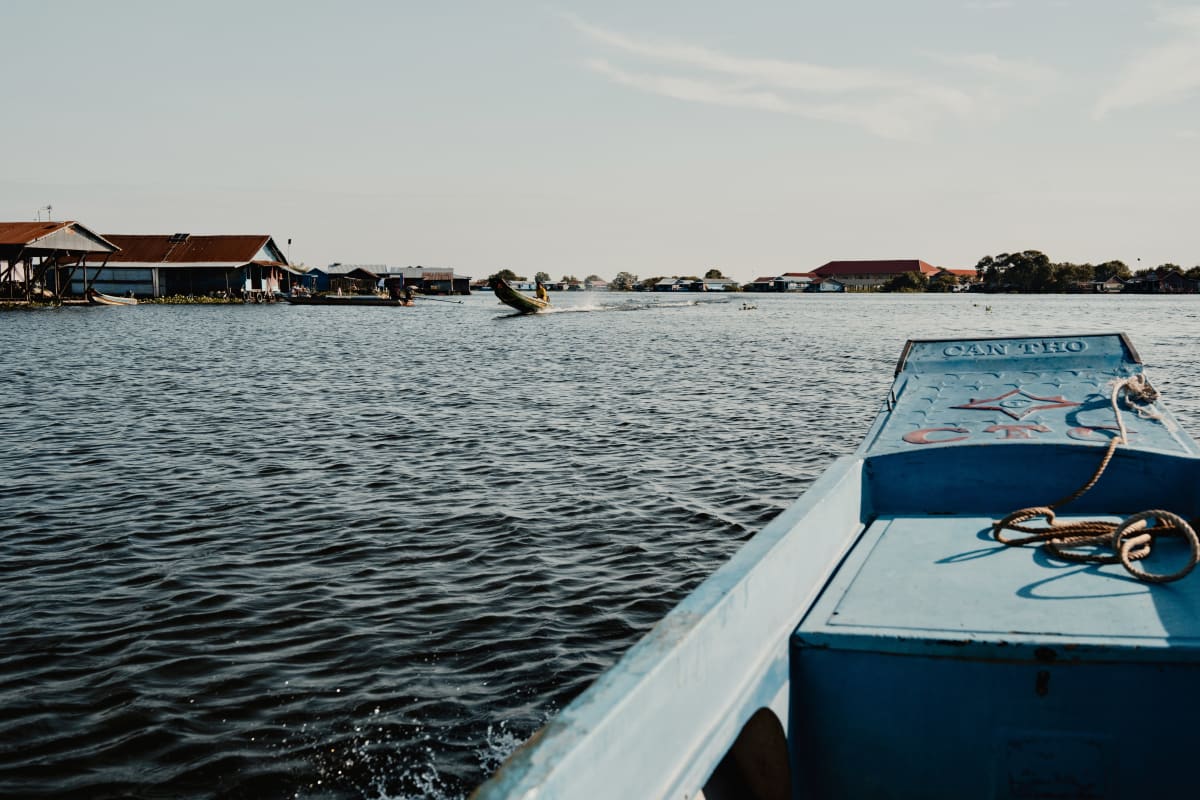
A fishing family’s house floats on the Tonle Sap, rising with the monsoon, sinking with the dry season, and moving when the lake does. Over 300 fish species swim beneath them. Irrawaddy dolphins move through the same water. Across the Mekong basin, nearly one in five fish species is threatened, and the communities who depend on every catch are watching the river change. This semester traces those connections: freshwater ecology, forest conservation, and environmental justice across the Lower Mekong.
Students measure fish morphology at Prek Toal, survey macroinvertebrates as the water rises, and spend one night in the floating village there, interviewing fishing families about livelihood change. Excursions to the Elephant Valley Project in Mondulkiri bring students alongside Bunong mahouts and Asian elephants in evergreen forest, deep in Cambodia’s eastern highlands, a world away from the temples of Angkor that frame their home base in Siem Reap.
PROGRAM HIGHLIGHTS
→Measure fish morphology at Prek Toal, collect water quality samples, and survey aquatic macroinvertebrates as bioindicators across the Tonle Sap flood-pulse ecosystem.
→Spend one night camping on Kulen Mountain and another at the Prek Toal floating village, interviewing ecotourism workers and fishing families about changing livelihoods and surveying birdlife across the Tonle Sap.
→Observe foraging behavior and assess elephant welfare, social behavior, and their role as ecosystem engineers at the Elephant Valley Project in Mondulkiri.
→Visit Bousra, Loav Ka, and Putrom to study indigenous land tenure, communal title, and natural resource access in Mondulkiri’s Bunong communities, and learn QGIS and fly drones over indigenous farmland in Kratie to produce aerial land-use maps.
→Study conversational Khmer, tour the Angkor Archaeological Park with a professional guide, attend the Phare Cambodian Circus, interview elders in Kratie and Stung Treng, and visit Tuol Sleng for genocide remembrance.
→Join a faculty-led Directed Research project that addresses real stakeholder questions in biodiversity, governance, or livelihood transformation. Past projects include watersnake bycatch and trade at Kampong Khleang, participatory land-use research with Indigenous communities, and organic-farm certification through the Participatory Guarantee System.
LOCATION
Students live and study at the SFS Center for Environmental Justice and Mekong Ecologies. The campus sits on the outskirts of Siem Reap, minutes from the Angkor ruins, in a river basin that holds over 1,200 fish species, Irrawaddy dolphins, and giant freshwater stingrays.
Students live two to four to a room, in five rooms with air conditioning and en-suite bathrooms, and there is a pool on campus. Siem Reap’s markets and cafes are a short tuk-tuk ride away, and evenings and some weekends leave time to explore the city’s restaurants and cultural sites.
RESEARCH THEMES
- Community Forests
- Farming Households
- Indigenous Land Use
- Tonle Sap Watersnakes
CORE SKILLS
- Primate Behavior Observation
- Freshwater Ecology Sampling
- Camera Trapping
- Community Livelihood Surveys
- GPS Habitat Mapping
- Forest Structure Assessment
- Fish Catch Monitoring
- Macroinvertebrate Surveys
LEARN MORE REQUEST INFORMATION APPLY NOW
CONNECT WITH SFS
Visit our website: fieldstudies.org
Email: admissions@fieldstudies.org
Follow us on Instagram
Learn more on our Vimeo
